

Why it is on the list
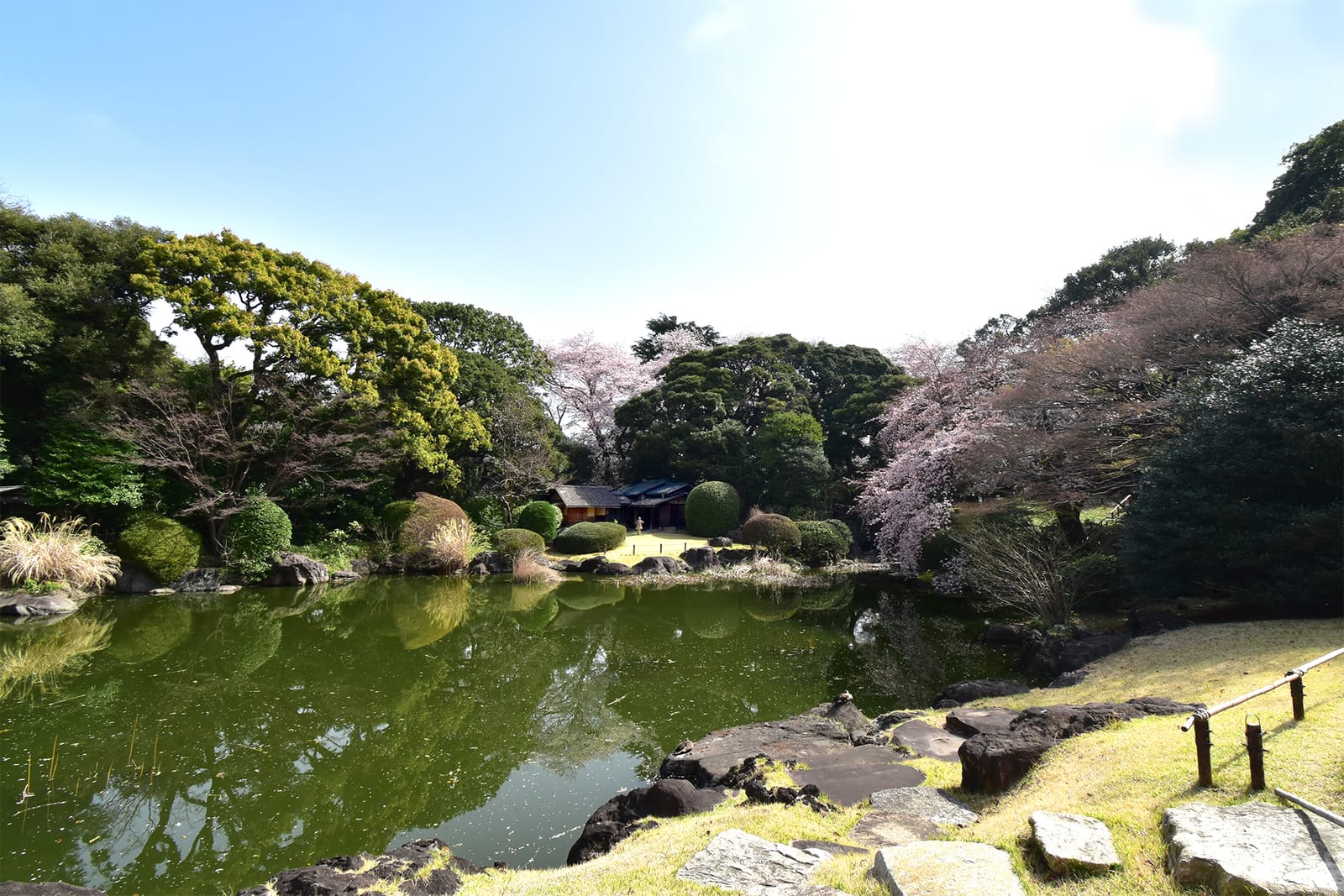
Rokusoan was built in the Keian era at Jigen'in, a sub-temple of Kofukuji in Nara, in the manner of the tea master Kanamori Sowa, and was counted one of the three representative teahouses of the Yamato region.1 The museum bought it in 1875. The ship carrying it sank off the Izu Peninsula; the timber was recovered and the house rebuilt in 1877, and after wartime evacuation the sukiya carpenter Kimura Seibei rebuilt it where it stands in September 1947.1 It is thatched, with a daime tea room of three mats, a two-mat anteroom, a three-mat room, a three-mat waiting room, a covered bench, stone lanterns and a double roji; the stone basin at its entrance was cut from the body of a pagoda raised at Hosshoji in 925.12
It holds 5 to 10, and is the wrong choice for a larger party.2 For about 20, ask instead for Tengoan, part of a sukiya Kobori Enshu built at Rokujizo in Fushimi; for 20 to 30, Kujokan, two ten-mat rooms from the Kujo ducal residence in Akasaka.2 A gathering of several hundred can take all the teahouses together.2 Okyokan, with the Maruyama Okyo room, is not being let at present.2
How to get it
Write to the museum's facilities office (General Affairs, venue rental) at kashidashi_tnm@nich.go.jp or call +81 3 3822 1111 and ask for Rokusoan on your date; a viewing beforehand can be arranged.2 A provisional booking opens on the first day of the month six months ahead and runs to the day before: for 15 August, from 1 February. The booking is confirmed once the museum approves its written application form, sent by email or by fax to +81 3 5809 0095, and an approval letter follows by post. Payment is by bank transfer against an invoice after the day.2 The day runs 9:30 to 16:00, setting up and clearing included. Rokusoan costs JPY 60,000 on a weekday and JPY 70,000 at weekends and on holidays, tax and utilities included.2 A cancellation after 17:00 on the previous business day is charged in full, unless weather or a similar outside cause forces it.2
The teahouse is let as it stands, with the museum's list of tea equipment; the host brings the catering and any lighting, eats and drinks only where the museum says, and takes the rubbish away. If the teahouse is free the day before, an hour from 16:00 to 17:00 can be used to lay out utensils at no charge; longer is charged at the day rate. No open flame indoors without the museum's agreement, no smoking inside, and no animals on the grounds; plants must be disinfected before they come in. Any sale of goods is agreed in advance.2 The garden may close in bad weather or for maintenance.1
Discretion
Guests come and go by the West Gate, not the Main Gate, where visitors pass metal detectors and bag checks.23 The museum asks every guest to wear a ribbon or badge, described or sent to its staff in advance, even with an invitation card; parking inside is allowed only for the host, by arrangement, and may be limited.2 The garden is part of the museum visit, so other visitors can be near the teahouse; the booking takes the teahouse, not the garden.12
Sources
- TOKYO NATIONAL MUSEUM - Exhibitions and Events Museum Garden and Teahouses. tnm.jp, read 28 October 2026.
- 東京国立博物館 - 東博について 施設有料貸出 茶室. tnm.jp, read 28 October 2026.
- TOKYO NATIONAL MUSEUM - Visitor Information Getting Here, Admission & Hours. tnm.jp, read 28 October 2026.
Last checked 3 November 2026, against the venue's own pages. The next check is due by 10 November 2026.